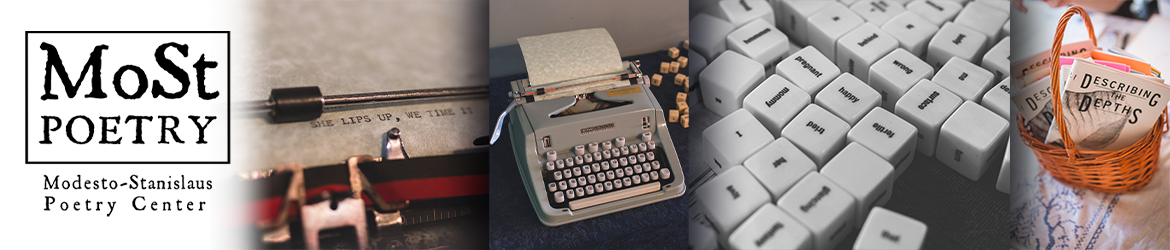

Second Tuesday Poetry featuring Caleb Nichols and Amanda Moore
Modesto-Stanislaus Poetry Center is pleased to present Second Tuesday Poetry featuring San Luis Obispo County Poet Laureate Caleb Nichols and San Francisco-based teacher and workshop leader Amanda Moore, author of the 2020 National Poetry Series-winning collection Requeening.
Date: Tuesday, November 10, 2026
Time: 7:00 pm; doors at 6:30 PM
Where: Bookish Modesto, 811 W. Roseburg Ave, in the Roseburg Square shopping center
Admission free. Refreshments, books, and merch available for purchase. Open mic following featured poets (3 min per poet); sign up at the event. Hosted by Gillian Wegener
CALEB NICHOLS
 Caleb Nichols is the first queer poet laureate of San Luis Obispo County California. Their poems have appeared in the New England Review, Poetry Wales, and many other places on both sides of the Atlantic. Caleb is the author of Lithic: A Hyperballad, winner of the 2024 Harbor Editions Laureate Prize and the editor of You & i Are Earth: Poems of the Queer Pastoral, published by 14 Poems (forthcoming in 2027). Caleb holds a PhD from Bangor University in North Wales and teaches at Cal Poly State University, San Luis Obispo. More at https://calebnicholis.gay.
ABOUT LITHIC: A HYPERBALLAD
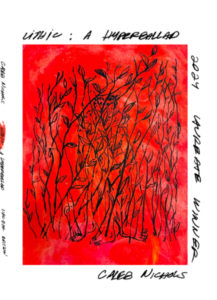
Lithic: A Hyperballad (2026, Harbor Editions Laureate Prize Winner) brings together a sequence of poems and a lyric essay that traverses memory, gender, landscape, and language—excavating a self shaped by place, queerness, ecological disquiet, and artistic lineage. As a work of queer ecopoetics rooted in both lyric and experimental inquiry, Lithic interrogates language, and nature, and digs deep to excavate meaning. Alongside the book, Nichols is releasing a spoken word collection called Stone Age Is Now: Poems From Lithic, on US label Royal Oakie. Across twelve tracks Nichols interpolates poems from Lithic: A Hyperballad with tracks from Stone Age Is Back, bringing new depth to his indie-rock and alt-folk compositions.
 Caleb Nichols’ formally restless and inventive poems are “equal parts sex and salvation,” filled with queer desire and bitter sweet elegy for the planet. Nichols searches for an opening through layers of stone into the mutability of awareness, asking not only how we survive but how we are survived. Inspired by and in dialog with the work of many other writers and musicians, Lithic pulls us along into its flow—a cloud-rich and penny-poor “catalog / of wants / a life spent / gathering.” From such a life and despite the world’s violences, the music of these poems rises as a resolute hallelujah.” — Mira Rosenthal, author of Territorial (Pitt Poetry Selection)
What if sound itself is narrative? The sound of the Welsh language, the sound of the river, the remixed sounds of the musics that haunt and bedrock this book, the sounds that are the matter of our lives and the sounds that are inside of us, our perception. In this collection, we’re asked to open ourselves “to listen to the hiss of cochlea coiling/ chambers unspooling releasing their crystalline sphinxes”. Caleb Nichols’ gift for orchestral and balsamic phrasing is like no-one else. — Colin Herd, author of Aquafaba (A Poetry Society Selection)
This book is so fresh, so musical and Björk-level playful you will want to dance and weep at the same time. These poems are physical events, undeniable eruptions. Trees pen essays, men become a “thicket of reciprocal moans,” an image roots itself in the sky, and the most alive thought is that which geysers forth from ambling and wending, from two feet meeting the earth again and again. With sacred repetition, dizzying queer desire, and “ancient grief,” Caleb Nichols shows us how to live in a larger reality, one where a “cloud’s shadow” is in fact “more real than the actual cloud.” — Chen Chen, author of Your Emergency Contact Has Suffered An Emergency
My favorite poems help me realize I only thought I knew this world. Caleb Nichols gives this and so much more—their poetry has a profound human touch. “This dirt belongs in the grooves of my skin / and your clay and my clay are kin”. This is a collection of poems for the ages, and I want everyone I know who moves through life with literature to get moving with Caleb Nichols! — CAConrad, author of First Light
AMANDA MOORE
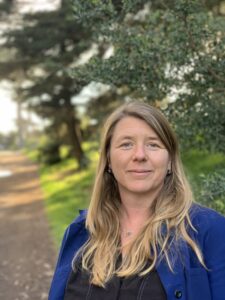 Amanda Moore’s debut collection of poetry, Requeening, was selected for the 2020 National Poetry Series by Ocean Vuong and published by HarperCollins/Ecco in October 2021. It was a finalist for the Northern California Book Award and featured in Oprah Magazine’s annual Favorite Things Issue. Her poems have appeared in journals and anthologies including Best New Poets, ZZYZVA, Ploughshares, Kenyon Review, and Mamas and Papas: On the Sublime and Heartbreaking Art of Parenting; her essays have appeared in Poets & Writers, The Baltimore Review, and Catapult; and her translations of Costa Rican poet Ana Istarú have been published or are forthcoming in Lunch Ticket and Poet Lore.
Poetry editor at Bull City Press’s INCH and co-organizer of the Poetry World Series, Amanda is a teacher, workshop leader, and woodworker who lives by the beach in the Outer Sunset neighborhood of San Francisco.
ABOUT REQUEENING
Engaging the matriarchal structure of the beehive, Amanda Moore explores the various roles a woman plays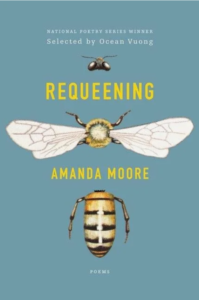 in the family, the home, and the world at large. Beyond the productivity and excess, the sweetness and sting, Requeening brings together poems of motherhood and daughterhood, an evolving relationship of care and tending, responsibility and joy, dependence and deep love.
The poems that anchor this collection don’t shy away from the inevitability of a hive’s collapse and consider the succession of “requeening” a hive as “a new heart ready to be fed and broken and fed again.” The collapse is both physical—there are poems of illness and recovery—and emotional, as the mother-daughter relationship shifts, the daughter becoming separate, whole, and poised to displace. The liminal spaces these poems traverse in human relationships is echoed in a range of poetic and hybrid form, offering freedom and stricture as they contemplate the way we hold one another in love and grief.
Requeening is a vivid and surprising collection of poems from a winner of the National Poetry Series Open Competition.
“A rare feat for any book of poems, let alone a debut, in that the lines, wrought with such deft precision and care, mark the sum total of a life richly lived and felt at the seat of poetry…These poems care, first and foremost, for what they write of and through, which is a much needed—yet increasingly rare—achievement.” -Ocean Vuong
“Moore’s debut collection is a winner of the 2020 National Poetry Series, and it’s clear why. Using imagery of the beehive and the matriarchal queen bee, Moore contemplates childbirth, motherhood, and marriage. A quietly profound work about the inevitable cycles of life.” -O, the Oprah Magazine
“Pinpointing pivotal moments, Moore looks at the love and anger between mother and daughter, as well as the way the daughter replaces the mother as the one who brings new life into the family. These highly descriptive poems evoke a dreamlike state, one that is quick-moving and evocative, temporarily erasing actual and imagined boundaries.” –Library Journal
“In her outstanding debut collection, Requeening, Amanda Moore imaginatively parallels the life of a woman in her family with the life of the queen bee in the hive. These poems take us through the sleepless nights of early parenthood, drunk with joy, through illness and recovery, through grief and fierce love. Often these poems evince a hard-earned dark humor. Just as she receives a cancer diagnosis, she writes, My 9th graders file into our room/ and I am at the whim of divine irony/…just as I have to teach a lesson/ on Odysseus’ journey to the Underworld. Always her images are precise and vivid, her understanding cogent, as when she compares mourning to Monet’s paintings: haystack, haystack, haystack…which is to say/ they are like this grief…/all the same but for the light. And when Moore describes the sand an Aunt collected from all over the world in a poem that ends, what we kept/ and what we stole, this past/ we’ve made from pilfered dust, we feel she is speaking a truth about all of our lives.” -Ellen Bass, author of Indigo